
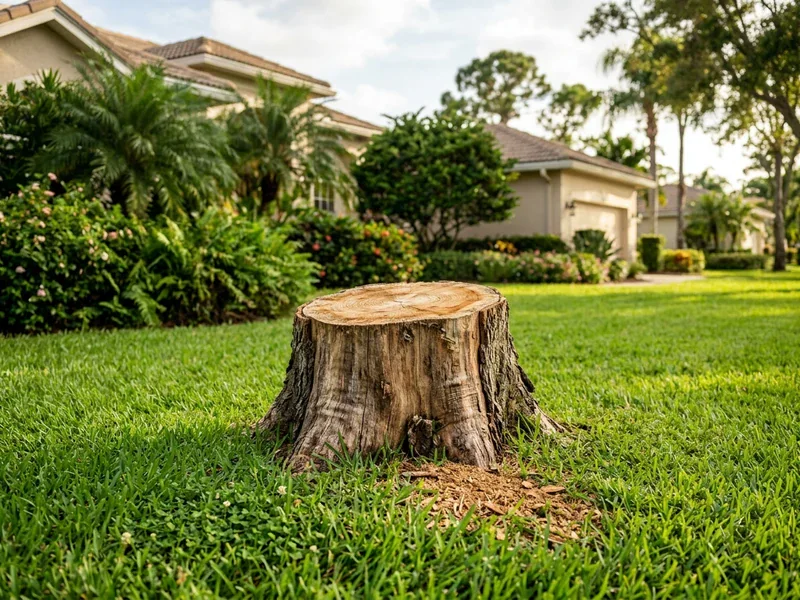
What Is Stump Grinding?
After a tree is cut down, the remaining stump can be mechanically ground below the surrounding soil surface.
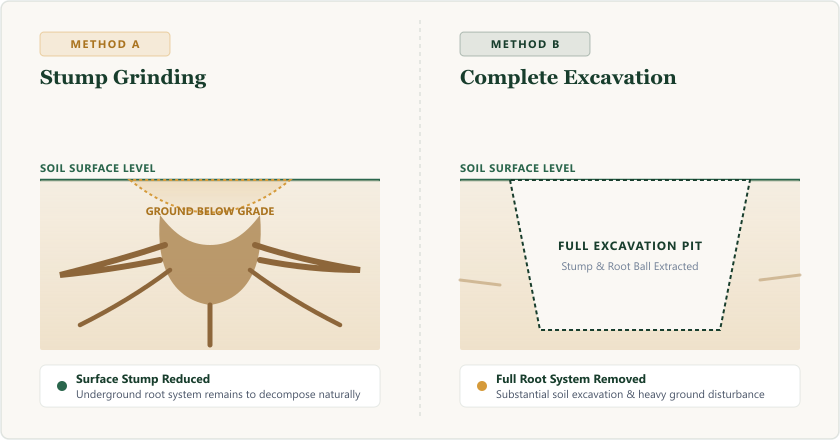
Stump grinding mechanically reduces the visible stump below grade — it does not excavate the entire root system.
Stump grinding removes the visible central stump without excavating the entire root system. Some species can still sprout from remaining stump or lateral-root tissue.
Stump Grinding vs. Complete Stump and Root Removal
These are different jobs with distinct mechanical approaches, soil disturbance levels, and landscape outcomes.
Mechanical Surface Reduction
Stump grinding breaks down the stump and upper portion of the wood below soil level.
For most landscaping situations, grinding creates less soil disturbance while allowing standard lawn restoration over the area.
Full Root Ball Removal
Complete removal involves substantially more excavation to remove stump and root material.
For construction, major regrading or other projects requiring a clear underground area, additional root removal may be necessary.
Why Grind a Stump?
Remove a Trip Hazard
Low stumps can be difficult to see in lawns or landscaped areas, creating safety concerns for foot traffic and mowing equipment.

Reclaim Usable Space
Grinding can make mowing, landscaping and future use of the area easier without navigating around an obstacle.

Improve Appearance
A decaying stump may remain visible for years, altering the visual symmetry of a manicured residential landscape.

Manage Unwanted Regrowth
Some tree species can resprout after being cut. Grinding alone may not prevent every type of regrowth, so ask the provider how the specific species should be handled.
Is Stump Grinding Included With Tree Removal?
Not necessarily included by default.
Stump grinding is frequently treated as an optional or separate line item. Always confirm whether the proposal includes:
- •Stump grinding: Mechanical reduction of the central stump base;
- •Depth of grinding: Specified depth below soil grade (e.g. 4–8 inches);
- •Cleanup of grindings: Wood chip debris disposal or backfilling on site;
- •Removal of surface roots: Exposed lateral roots crossing lawn areas;
- •Filling the hole: Topsoil backfill to grade level;
- •Haul-away: Transport and complete removal of surplus ground mulch.
Can I Plant Another Tree in the Same Spot?
Grinding does not create a completely root-free planting area.
If you plan to plant a substantial new tree in the same location, discuss the remaining root system, soil condition and planting position with a qualified landscape or tree professional rather than assuming the old planting hole is ready for immediate reuse.
Decaying roots consume nitrogen and restrict new root expansion.
Planting 3–5 feet away often provides superior soil and moisture conditions.