On This Page (Table of Contents)
When Is Tree Damage an Emergency?
Tree damage becomes urgent when there is an immediate threat to people, access, buildings, vehicles, utilities or other important targets.
UF/IFAS recommends prioritizing hazards first after storms — particularly fallen or hanging material, severely leaning trees and damaged trees threatening people or property.
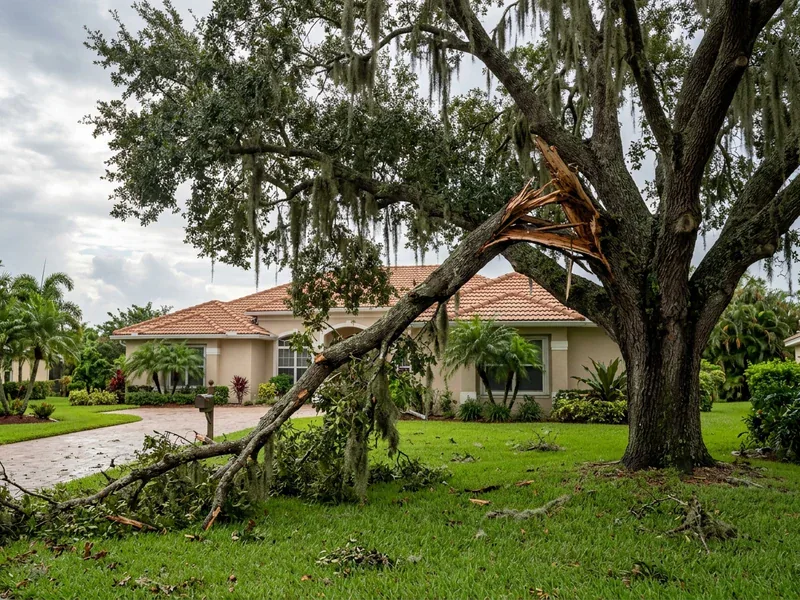
Prioritize target isolation before attempting any tree work. A tree resting on a roof, blocking primary road access or leaning over occupied living areas requires urgent professional hazard mitigation, whereas defoliated or cosmetically damaged trees can safely await standard scheduling.
What to Do First
Follow this four-step immediate safety sequence before anyone approaches a storm-damaged tree:

Keep People Away
Do not allow people to walk or park beneath hanging branches or unstable trees.

Look for Electrical Hazards
If a tree, branch or debris is contacting or close to an electrical line, stay away.
FPL says downed power lines should be treated as energized. For downed lines or damaged electrical equipment, contact emergency services and report the hazard to the utility.

Do Not Attempt High-Risk Cutting Yourself
Chainsaw work involving leaning trees, suspended branches, storm-loaded wood or trees next to buildings can change suddenly as wood is cut.
Professional help is appropriate for hazardous trees, large hanging limbs, leaning trees and difficult restoration work.

Determine Whether Removal Is Actually Necessary
A damaged tree can sometimes be restored. Do not assume that every storm-damaged tree must immediately be cut down.
Can a Storm-Damaged Tree Be Saved?
Sometimes.
UF/IFAS notes that many trees can recover from significant canopy damage. Good restoration candidates generally retain sound roots, trunk and major structural limbs without serious decay or major cracks.
A severely cracked main trunk, major root failure or another structural condition that creates unacceptable risk can shift the decision toward removal.
Recovery May Be Possible
Trees with intact root systems, sound central trunks, and minor-to-moderate limb breakage can often be preserved through selective structural pruning and staged crown restoration.
Professional Assessment May Indicate Removal
Extensive trunk splitting, uprooted root plates, severe structural decay, or hazardous leans toward homes that create an unacceptable risk generally warrant complete removal.
Emergency Removal and Florida Tree Law
An emergency situation does not automatically mean that every local rule disappears.
Florida Statute §163.045 creates a specific exception for qualifying residential property when an ISA Certified Arborist or Florida licensed landscape architect documents that the tree presents an unacceptable risk and that removal is the only practical way to reduce the risk below the required threshold.
When immediate life or electrical safety is involved, address the emergency first and obtain guidance from the appropriate authority or qualified professional.
Read our complete Port St. Lucie Permit & Regulation Guide →
Frequently Asked Questions About Emergency Tree Removal
Who do I call if a tree falls on a power line?
Stay away and treat the line as energized. Contact emergency services and the utility provider.
Does every tree damaged by a hurricane need removal?
No. Many trees can recover when their main structural components remain sound.
Can I cut a hanging limb myself?
High, loaded or suspended branches can be dangerous. Professional assessment is appropriate for hazardous storm damage.